


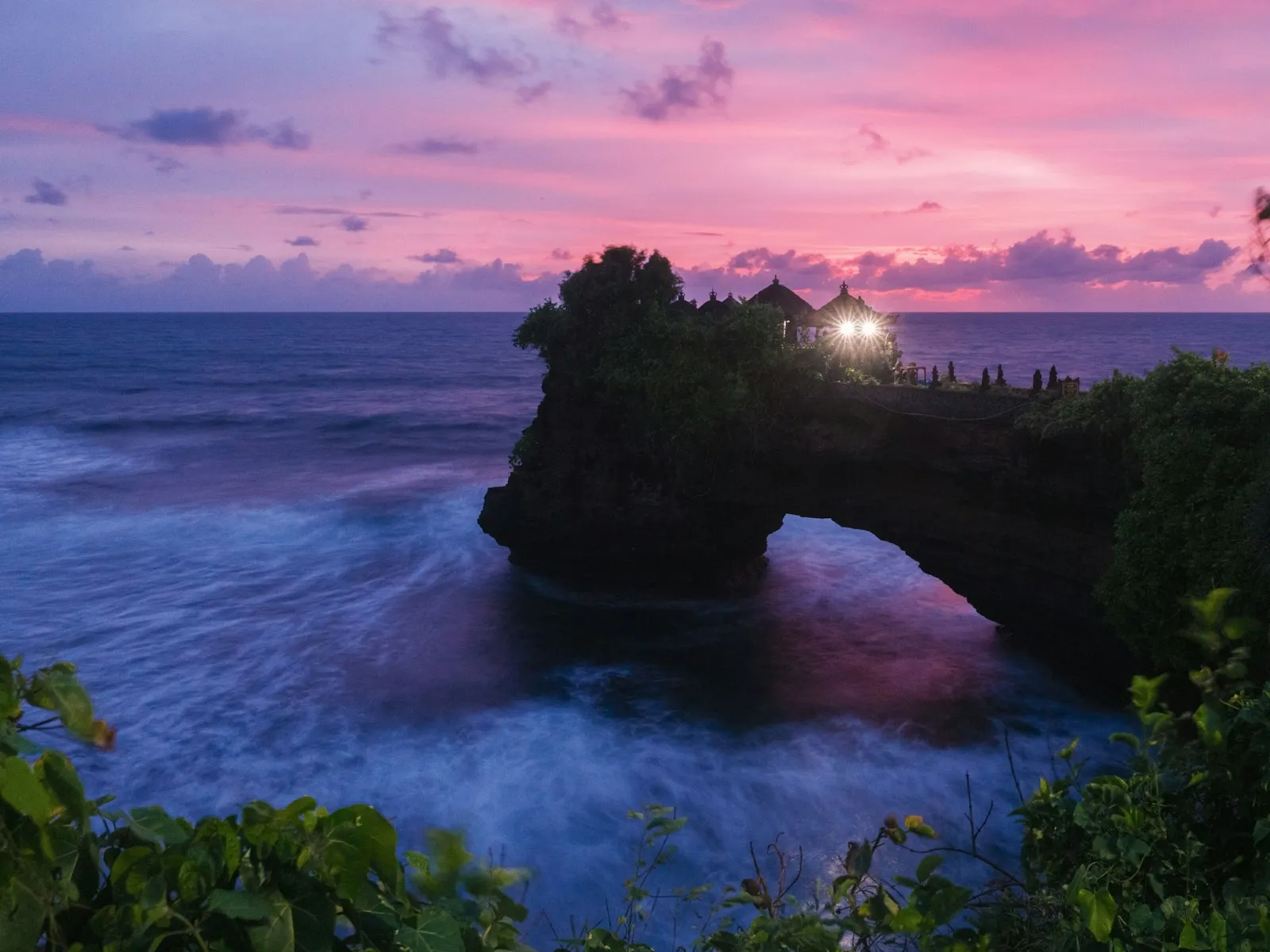
Uluwatu and Tanah Lot: the sunset pair
Uluwatu is Bali's best temple visit, and sunset with the kecak dance is the way to do it. Uluwatu Temple hangs on a 70-metre sea cliff; entry is about IDR 60,000 as of July 2026, and the sunset kecak fire dance in the clifftop amphitheatre costs IDR 150,000 and often sells out before 17:00, so buy tickets early and guard your sunglasses from the monkeys. Tanah Lot (IDR 100,000 after an April 2026 increase) photographs beautifully at sunset, but expect shoulder-to-shoulder crowds on the terraces, and know that visitors cannot enter the offshore temple itself.
Besakih: the mother temple
Besakih is Bali's most important temple complex, and the ticket now covers most of the old hassle. Besakih Temple spreads dozens of temples up the slope of Mount Agung. The IDR 150,000 foreigner ticket (as of July 2026) includes a sarong, the shuttle up the hill and an official guide, which has largely ended the freelance-guide pressure the site was once notorious for. Ceremonies happen almost daily, so some courtyards may be closed to visitors: that is worship taking priority, not a trick.
Lempuyang: the Gates of Heaven queue, honestly
The Gates of Heaven photo costs half a day of queueing. At Lempuyang Temple you take a numbered ticket for the photo spot, and waits of two to four hours are normal from mid-morning. The floating reflection in every famous shot is a mirror held under the phone by the photo marshal; there is no water there. Quoted entry varies with what gets bundled in, roughly IDR 55,000 to 150,000 plus about IDR 50,000 for the shuttle up from the car park as of July 2026. Arrive before 7:00, or visit it as a mountainside temple rather than a photo stop.
Tirta Empul and Ulun Danu Bratan: the water temples
Tirta Empul is a living purification site, and visitors may join the ritual if they do it properly. At Tirta Empul Temple (IDR 75,000 as of July 2026) you bathe in a rented sarong and move along the spouts from left to right, skipping the final ones reserved for funerary rites. Go with a local guide the first time and treat it as worship, not a pool. Ulun Danu Beratan Temple (raised to IDR 100,000 in July 2026) sits on a cool mountain lake and is best before the day-trip buses arrive around 10:00.
Goa Gajah and the rules that apply everywhere
Every Balinese temple asks the same things: covered shoulders, a sarong and sash, and quiet respect. Goa Gajah (about IDR 50,000, sarong included) packs a carved demon-mouth cave, ancient bathing pools and a jungle ravine into an easy stop near Ubud. Sarongs are lent or included at nearly every major temple, so you rarely need your own. One rule to know in advance: Balinese custom asks women who are menstruating not to enter temple grounds. It is a traditional purity rule that applies to Balinese worshippers too, it operates on trust, and honouring it quietly is part of being a good guest.
Fees, touts and the "temple is closed" trick
Buy tickets only at official booths, and doubt anyone who tells you the temple is closed. The classic move near the big temples is a friendly stranger announcing the site is shut for a ceremony, then steering you to their own tour, shop or "alternative temple"; real closures are rare and usually partial. Expect entry fees between roughly IDR 50,000 and 150,000 at the big names as of July 2026, in cash at the smaller sites. Opening hours and ceremonies shift with the Balinese calendar, so checking ahead on your phone (a Bali eSIM keeps you online even at the rural temples) saves wasted drives.