

Fast boats from Sanur, the main port
Nearly everyone reaches Nusa Penida by fast boat from Sanur, the main departure point on Bali's southeast coast. Sanur has more operators and more daily departures to Penida than anywhere else, with boats running through the day from early morning until late afternoon. The crossing is short, roughly 30 to 45 minutes in normal conditions, though it varies by operator and by how the sea is behaving on the day. Boats land on Penida's north coast, usually around Toya Pakeh or Banjar Nyuh, where drivers and rental places wait. If you are staying in south Bali, Sanur is also the closest and simplest port to reach.
Other places you can leave from
Sanur is not the only option: fast boats also run to Nusa Penida from Padang Bai in the east and from a few other points along the coast. Padang Bai suits travellers already in east Bali or combining Penida with the Gili Islands, which use the same harbour. Some boats also connect Penida with neighbouring Nusa Lembongan, so hopping between the two islands is straightforward. Wherever you leave from, aim for a morning boat: departures thin out in the afternoon, and an early start gives you the daylight you need on an island that takes real time to cross.
Day trip or stay the night?
A day trip to Nusa Penida is doable but long and rushed, and the island is bigger and rougher than most people expect. The classic day tour packs the headline viewpoints into one exhausting run: an early boat, a full day bouncing along poor roads, and a late-afternoon crossing back. You spend much of the day in transit and queuing at the busiest lookouts. Staying one or two nights changes the trip completely, letting you reach the famous spots early before the day-trippers arrive and see more than the southwest corner. If you only have a day, accept that you will see a slice of Penida, not all of it.
Booking the boat and the choppy crossing
Book both your outbound boat and your return in advance, and treat the sea crossing as the part most likely to change. Fast boats are open-water craft on a channel that can get genuinely choppy, so a smooth ride one morning can be a rough one the next. If you are prone to seasickness, take something before boarding and sit low and central. Hold on to your return ticket and confirm the last departure time, because missing the final boat means an unplanned night on the island. Rough weather occasionally cancels crossings outright, so build a little slack into tight onward plans.
Getting around the island
Getting around Nusa Penida is the hard part: the roads are narrow, steep and often broken, so hire a driver or ride only if you are an experienced scooter rider. Many first-timers underestimate the terrain and come unstuck on the rutted tracks to the western viewpoints, which stay slow and rough even in a car. A local driver for the day is the low-stress choice and lets someone who knows the roads handle the worst of them. Phone signal is patchy in places, so a working data plan matters for maps and for coordinating your driver or boat by phone. Setting up a Goodbars eSIM before you travel keeps that connection live from the moment you land.
The famous viewpoints
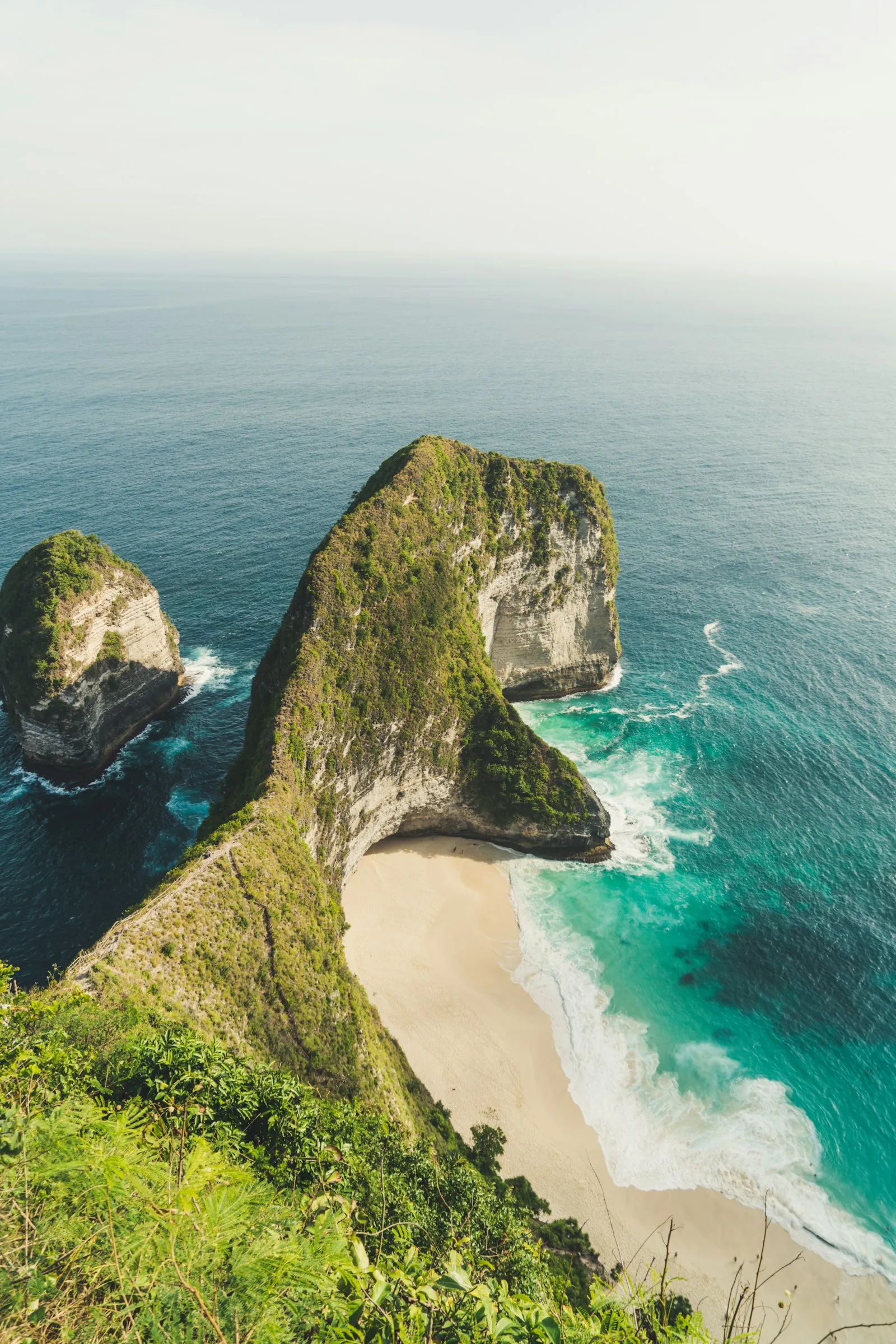
Penida's fame rests on a handful of dramatic public spots, most of them on the wilder west and south coasts. Kelingking is the postcard, a cliff shaped like a dinosaur's back above a beach far below, and the steep descent to the sand is a serious climb best skipped in the midday heat. Nearby, Angel's Billabong is a natural rock pool and Broken Beach a round cove with a natural arch, the two sitting close together. On the calmer side, Crystal Bay is the main swimming and snorkelling beach and an easier stop. All of these fill up from mid-morning as the day boats arrive, so go early where you can.