

Yogyakarta
Yogyakarta is Java's cultural heart: two UNESCO temple complexes on its doorstep, a living palace court, batik and gamelan, and Mount Merapi on the skyline. It is the trip most people add to Bali when they want depth as well as beaches.
Yogyakarta in a nutshell
Yogyakarta is Java's cultural capital, a university city of roughly 400,000 people that still runs as a sultanate with its own palace and its own special-region status. Locals shorten it to Jogja. It sits on a plain between the Indian Ocean and Mount Merapi, one of the world's most active volcanoes, which fills the northern skyline on clear mornings. The draw here is depth rather than beaches: two UNESCO temple complexes within about an hour's drive, a living court culture of batik, gamelan and shadow puppetry, excellent, cheap Javanese food, and a young student energy that keeps the streets busy late.
Borobudur and Prambanan
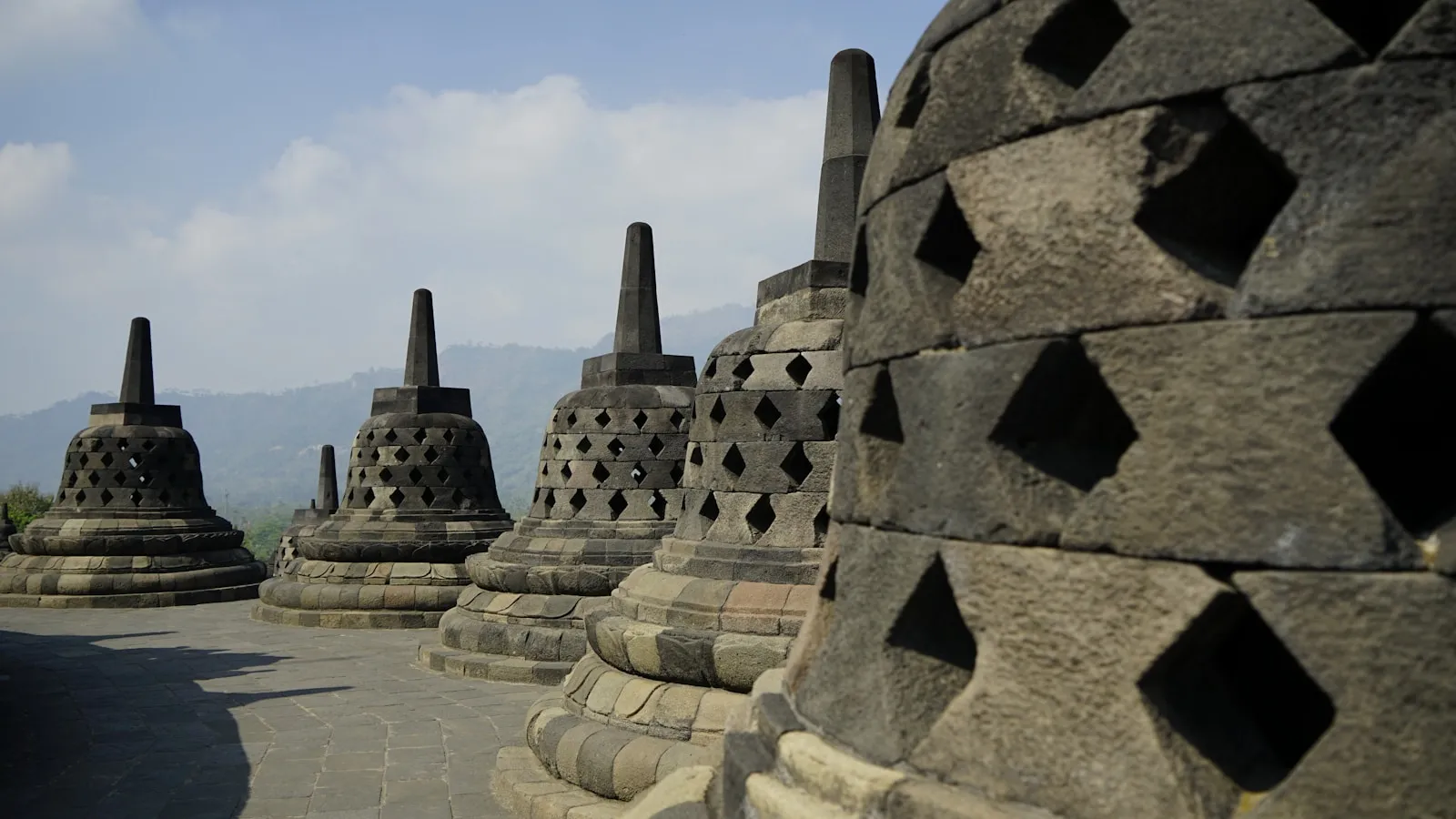
Borobudur and Prambanan are the two UNESCO World Heritage temple complexes that bring most visitors to Yogyakarta, and both sit within about an hour's drive of the city. Borobudur is a ninth-century Buddhist monument of stacked stone terraces and bell-shaped stupas; Prambanan is the tall, spired Hindu complex from roughly the same era, closer to town. Be careful with sunrise plans. Access rules at Borobudur have changed repeatedly since the site reopened after the pandemic, and as of July 2026 climbing onto the monument itself and any dawn slot are ticketed separately from ordinary grounds entry, limited in number and normally booked ahead. Check the official channels before you build a pre-dawn morning around it.
The Kraton, Malioboro and the crafts
In the city itself the anchor is the Kraton, the walled palace complex that is still the sultan's residence and the centre of Javanese court culture. Gamelan music and classical dance are performed there on a published schedule, and the Taman Sari water castle ruins nearby make an easy add-on. Malioboro is the main street, a long crowded run of stalls, batik sellers and street food that has been pedestrianised in stretches: touristy, and worth an evening anyway. Batik is the city's craft signature and workshops around town will walk you through the wax-and-dye process. Haggling at market stalls is normal, and opening prices usually start high.
Getting there and getting around
Most travellers fly in: Yogyakarta International Airport (YIA) at Kulon Progo took over commercial flights from the old Adisutjipto airport in 2020, and a direct hop from Bali takes roughly an hour and a half. YIA is about 40 kilometres west of the centre, further out than the old airport, with an airport rail link and shuttle buses covering the transfer in roughly 40 minutes to an hour. From Jakarta the train is the better story: executive services run the route in about six to eight hours, and they sell out around holidays. In town, Gojek and Grab are cheap and everywhere, and the temple trips are usually done with a hired car and driver.
Why travellers pair it with Bali
Yogyakarta is the usual answer to what else you should see in Indonesia, because it gives a Bali trip the historical weight that Bali's south coast does not. Three or four days is the common shape: two temple mornings, a day in the city, and a Merapi jeep tour or a village day if time allows. It works in either direction, as a stop on the way in from Jakarta or a short flight out of Denpasar and back. The dry season, roughly April to October, gives the clearest volcano views and the best odds on a bright early start; the wetter months are greener and quieter, but cloud often takes the sunrise away.
Staying connected in Yogyakarta
Yogyakarta is one of the Indonesian cities where Telkomsel 5G is live, and Goodbars runs on Telkomsel, the network with the widest reach in the country. In practice the centre is fast, while the temple sites, the Merapi foothills and the villages out towards the coast fall back to 4G/LTE, which is still comfortable for maps, messaging and video calls. Signal thins at altitude, so download an offline map before a volcano morning. As an eSIM it installs before you fly and switches on when you land, so you leave YIA already online instead of hunting a SIM counter after a domestic hop. For a few days of maps, ride-hailing and photo uploads the 20GB plan leaves comfortable room.
Common questions
Is Yogyakarta worth visiting?
Yes, if you want culture and history rather than beaches. It is the easiest base for Borobudur and Prambanan, two UNESCO temple complexes, and it has a living palace court, batik and gamelan traditions, excellent cheap food and Mount Merapi on the horizon. Most people add three or four days to a Bali trip.
How do you get from Bali to Borobudur?
Fly from Denpasar to Yogyakarta International Airport (YIA), roughly an hour and a half in the air, then continue by road. Borobudur is about an hour's drive from Yogyakarta, and most visitors use a hired car and driver or a day tour rather than public transport. There is no direct flight to the temple.
Can you still watch the sunrise at Borobudur?
Sunrise access is restricted and has changed several times since the site reopened after the pandemic. As of July 2026 a dawn slot and climbing onto the monument itself are ticketed separately from ordinary grounds entry, capped in number and normally booked in advance. Check the official channels before planning a pre-dawn trip, and treat third-party tour listings with caution.
How many days do you need in Yogyakarta?
Three or four days covers it comfortably: a morning at Borobudur, a late afternoon at Prambanan, a day for the Kraton, Taman Sari and Malioboro, and a spare day for a Merapi jeep tour or a batik workshop. Two days is possible but leaves the temple mornings feeling rushed.
When is the best time to visit Yogyakarta?
The dry season, roughly April to October, is the safer window: clearer skies for the temples and the best chance of seeing Mount Merapi. The wet season, about November to March, is greener and quieter, with heavy afternoon rain and cloud that often hides both the volcano and the sunrise.
Is there mobile coverage at Borobudur and Prambanan?
Yes. Telkomsel covers both temple areas on 4G/LTE, which is fine for maps, messaging and uploads, while Yogyakarta city is among the Indonesian cities with 5G. Reception thins in the Merapi foothills and the deeper countryside, so save an offline map if you are heading up the volcano before dawn.
On the map

Wherever you goSTAY ONLINE
Pick a plan, install in minutes, and step off the plane connected in Bali. From €13.99.
See the plans- No ID needed
- No contract
- Instant email delivery
- Works on arrival