

Java
Java is Indonesia's main island: the capital, more than half the country's population, and a line of volcanoes running its full length. It is where a Bali trip goes to gain historical weight, with the temples around Yogyakarta at one end and the Bromo caldera at the other.
What Java actually is
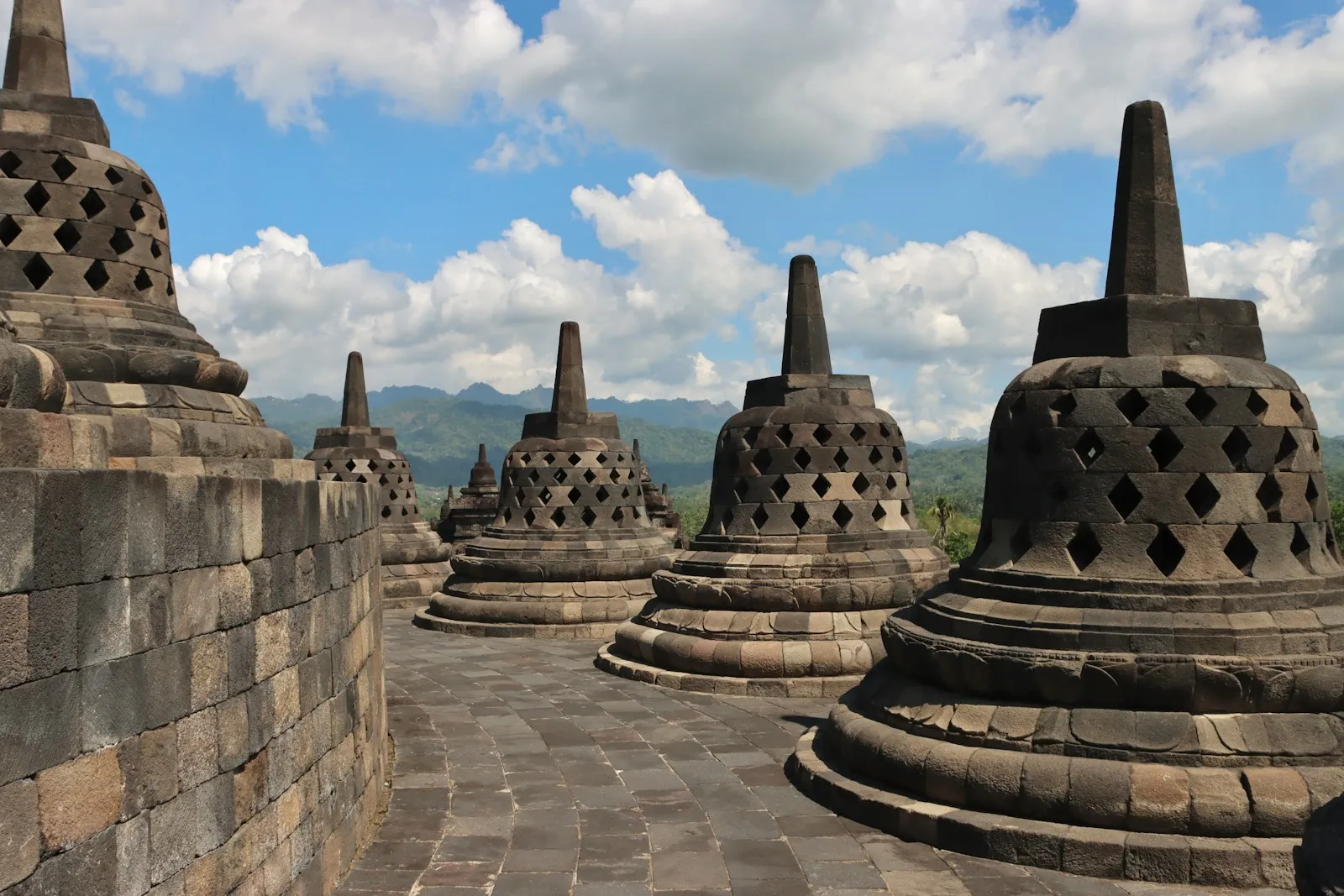
Java is where Indonesia is run from and where most Indonesians live, which makes it a very different trip from Bali. The island holds the capital, the parliament, the largest universities and, by most counts, more than half the national population. A volcanic spine runs its full length, so the land is both extraordinarily fertile and lined with cones that dominate the view from almost any road. What that gives travellers is cities with real weight, two UNESCO temple complexes outside Yogyakarta, and volcano country in the east. Beaches exist, but nobody comes to Java for them.
Yogyakarta, Bromo and Jakarta
Three places carry most Java trips, and each asks something different of you. Yogyakarta is the cultural base: a university city that still runs as a sultanate, with Borobudur and Prambanan, two UNESCO temple complexes, each about an hour's drive away, and Mount Merapi on the northern skyline. Mount Bromo, at the eastern end of the island, is an active cone inside a huge ash-filled caldera, seen on a pre-dawn jeep run from the rim village of Cemoro Lawang. Jakarta is the capital and a metropolitan region of roughly 30 million people: heavy traffic, museums, a colonial old town at Kota Tua, and the best food on the island.
Getting there and crossing the island
Fly into one end and work your way to the other, because doubling back across Java costs whole days. From Bali a direct flight to Yogyakarta International Airport takes roughly an hour and a half, and the airport sits about 40 kilometres west of the city, with a rail link and shuttle buses covering the transfer. Soekarno-Hatta in Jakarta is the main international gateway and has an airport train into the centre. Between cities the train is the civilised choice: executive services run Jakarta to Yogyakarta in about six to eight hours and sell out around holidays. Bromo is reached by road from Surabaya or Probolinggo, and is a full travel day from Yogyakarta.
When to go
The dry season, roughly April to October, matters more here than on most Indonesian islands, because Java's headline sights are views that cloud simply deletes. A clouded-in morning at Bromo or Borobudur is a common outcome in the wetter months, roughly November to March, when rain is heavy and Merapi spends most days hidden. The dry months are the busy ones: the popular Bromo viewpoints fill up and train seats go early around Indonesian holidays. Access is managed as well, and as of July 2026 entry to both Borobudur and the Bromo park is normally booked ahead through official channels, with limits that change, so check close to your date. Altitude counts too: the main Bromo viewpoint sits at around 2,700 metres and can approach freezing before dawn.
Who Java suits, and who it does not
Java rewards travellers who want history, cities and volcanoes, and frustrates anyone looking for a beach holiday with better temples. The trip runs on early starts, long road and rail legs, city heat and traffic, and cold air at altitude. It fits culture-first travellers, photographers, anyone curious about how the country actually works, and Bali visitors who want more depth in a longer trip. It fits poorly if your transfers need to be short, if a 2 to 3am alarm is out of the question, or if you want to unpack once. A week is the practical minimum for Yogyakarta and Bromo together, and ten days is more comfortable if Jakarta goes in.
Staying connected across Java
Java is the best-connected part of Indonesia after Bali's south, right up until you start climbing. Goodbars runs on Telkomsel, the network with the widest reach in the country. As of July 2026 Telkomsel 5G is live in parts of the big cities, Jakarta and Yogyakarta among them, while the areas around them run on 4G/LTE, which is comfortable for maps, messaging and video calls. Volcano country is where it thins: the Merapi foothills, the sand sea at Bromo and the higher viewpoint roads all lose signal, so download offline maps, tickets and accommodation details before an early start. An eSIM installs before you fly and switches on when you land, which counts here because ride-hailing, transit apps and QR payments all assume you are already online.
Common questions
Is Java worth visiting?
Yes, if you want history, cities and volcanoes rather than beaches. Java has two UNESCO temple complexes near Yogyakarta, the Bromo caldera in the east, and the food and museums of Jakarta. It is a working island rather than a resort one, so expect early starts and long travel days.
How many days do you need in Java?
A week is the practical minimum for Yogyakarta and Mount Bromo together, allowing three or four days for the temples and the city and two nights at the caldera rim. Ten days is more comfortable if you add Jakarta or continue east to the Ijen crater and cross to Bali by ferry.
How do you get from Bali to Java?
Most travellers fly. Denpasar to Yogyakarta International Airport takes roughly an hour and a half, and there are flights to Jakarta and Surabaya as well. Overland, the route runs by road and ferry across the strait at the eastern end of Java, which is why many people travel Java west to east and finish in Bali.
What is the best way to travel around Java?
Trains between the cities and road transport for the volcanoes. Executive services cover Jakarta to Yogyakarta in about six to eight hours and sell out around holidays. Mount Bromo is reached by road from Surabaya or Probolinggo. Inside cities, Gojek and Grab are cheap and everywhere, and Jakarta's MRT and TransJakarta beat sitting in traffic.
When is the best time to visit Java?
The dry season, roughly April to October, gives the clearest volcano views and the best odds on a bright sunrise at Bromo or Borobudur. The wetter months, about November to March, are greener and quieter but bring heavy afternoon rain and cloud that often hides both the volcanoes and the dawn.
Does mobile data work well in Java?
In the cities, yes. As of July 2026 Telkomsel 5G is live in parts of the big cities including Jakarta and Yogyakarta, with 4G/LTE across the areas around them. Coverage thins in volcano country: the Merapi foothills, the Bromo sand sea and the higher viewpoint roads all drop out, so download offline maps first.
On the map

Wherever you goSTAY ONLINE
Pick a plan, install in minutes, and step off the plane connected in Bali. From €13.99.
See the plans- No ID needed
- No contract
- Instant email delivery
- Works on arrival