An official list, from 1990
Japan does not leave this to travel blogs: the Ministry of the Environment published a list of Japan's Top 100 Waterfalls in 1990, and all four falls below are on it. The list is a national selection rather than a ranking, though the Fukuroda entry is commonly described as the third most beautiful in the country, after Kegon and Nachi. What the list will not tell you is the practical part, because opening hours, viewing platforms, ropeways and any entrance charges are run locally and change: we have not verified fees or hours for any of these, so check the operator's own page before you plan the day. What we can tell you is what each fall is, where it sits and what it pairs with.
Kegon, above Nikko
Kegon Falls drops about 97 metres out of Lake Chuzenji, in Nikko National Park near the city of Nikko in Tochigi Prefecture. The lake is the source of the Oshiri River, and the falls exist because the Daiya River was rerouted by lava flows; about twelve smaller waterfalls leak through the cracks between the mountain and the lava behind and to the sides of the main drop, which is the detail that makes the viewpoint worth the stop. In 1927 Kegon was named one of the Eight Views that best showed Japan and its culture. One honest warning: in autumn the traffic on the road from Nikko up to Chuzenji can slow to a crawl as people come for the foliage, so go early or go on a weekday. Nikko itself covers a large stretch of rural Tochigi about 140 kilometres north of Tokyo, and its 103 shrine and temple structures were inscribed by UNESCO in 1999.
Nachi, the tallest single drop
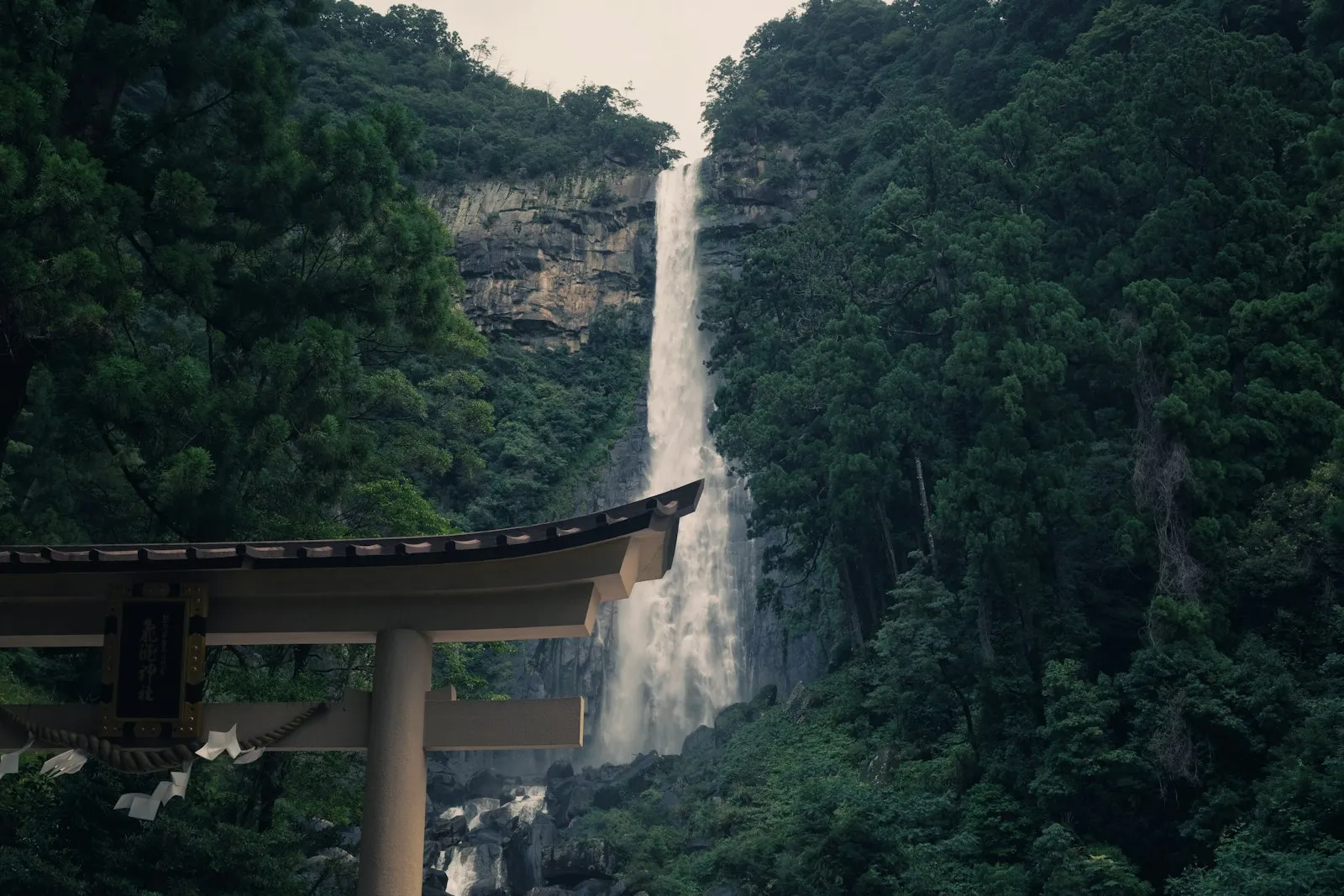
Nachi Falls, in Nachikatsuura in Wakayama Prefecture, drops 133 metres in one uninterrupted fall and is 13 metres wide, which makes it the tallest single-drop waterfall in Japan. Taller Japanese falls exist if you allow multiple drops: Hannoki at 497 metres, which is seasonal, and Shomyo at 350 metres, which runs year round. What sets Nachi apart is that it is not scenery but a place of worship. Two rocks at the top are the guardian kami of the falls and of the Shinto shrine beside them, and early each morning the Shinto priest makes offerings to the waterfall in a ritual. A Buddhist temple stood here too until it was destroyed during the Meiji Restoration in the late nineteenth century. Behave as you would at any shrine: bow at the gate, keep your voice down, and ask before photographing anyone.
Fukuroda, four tiers in Ibaraki
Fukuroda Falls, in the town of Daigo in Ibaraki Prefecture, is 120 metres at its highest point and 73 metres wide, and it comes down in four main tiers. It is a nationally designated Place of Scenic Beauty as well as one of the 1990 hundred, and it is commonly described as the third most beautiful waterfall in Japan, after Kegon and Nachi. The cliff it falls over was formed by volcanic ejecta some 15 million years ago, which is why the shape is stepped rather than sheer. It is also the easiest of these four to reach without a car: the closest station is Fukuroda on the JR East Suigun Line, 3 kilometres away. That last stretch is a local matter of buses, taxis or walking, and none of those is something we can promise for your day, so check locally when you arrive.
Shiraito, on the Fuji side
Shiraito Falls, in Fujinomiya in Shizuoka Prefecture, is only 20 metres high and belongs to a bigger story. It is part of the Fuji-Hakone-Izu National Park and has been protected as a Natural Monument since 1936, and in 2013 it was added to the World Heritage list as part of the Fujisan Cultural Site, the same inscription that covers the mountain. The falls were regarded as sacred under the Fuji cult, which is the reason they are in that listing at all rather than on scenery alone. If you are already spending a day around the mountain, this is the stop that fits: another waterfall, Otodome, slightly taller at 25 metres, is about a five-minute walk away, so the two go together without any planning.
When to go, and what each one pairs with
Autumn is the season everyone wants, and it is also the season the roads seize up. Autumn colour in Japan usually runs from late October to early December and moves with the weather, so no date is safe to book a year ahead; Kegon is the clearest case, because the same foliage that makes the trip also fills the road from Nikko. Summer brings the rain and the typhoons, which is worth knowing before you drive into a river valley.
Pairing is simple. Kegon belongs to a Nikko day, with the shrines and temples. Shiraito belongs to a Fuji or Kawaguchiko day. Nachi is a Wakayama trip, the same prefecture as Koyasan. Fukuroda is its own small train day out of the Kanto plain. On signal, our carrier's own notes say mountains and remote areas can still be out of reach, so download the maps first. Goodbars sells a Japan eSIM you install at home and switch on when you land; it runs on NTT docomo, Japan's largest mobile network by mobile contracts, and our Japan coverage page shows where it reaches and what independent speed tests measure.