Two Japans, one season
In winter the northwest wind drops its snow on the Sea of Japan side, and the Pacific side stays dry. That is why Tokyo's driest month is February, at 56.5 mm of rain against 234.8 mm in October, and why a January week in Tokyo and Kyoto is usually clear and cold rather than grey. Cross the mountains, or fly to Hokkaido, which has a humid continental climate with long, very cold winters, and you are in the other Japan entirely. Plan a winter trip as one or the other, or accept a long train ride between them.
Sapporo and the snow festival
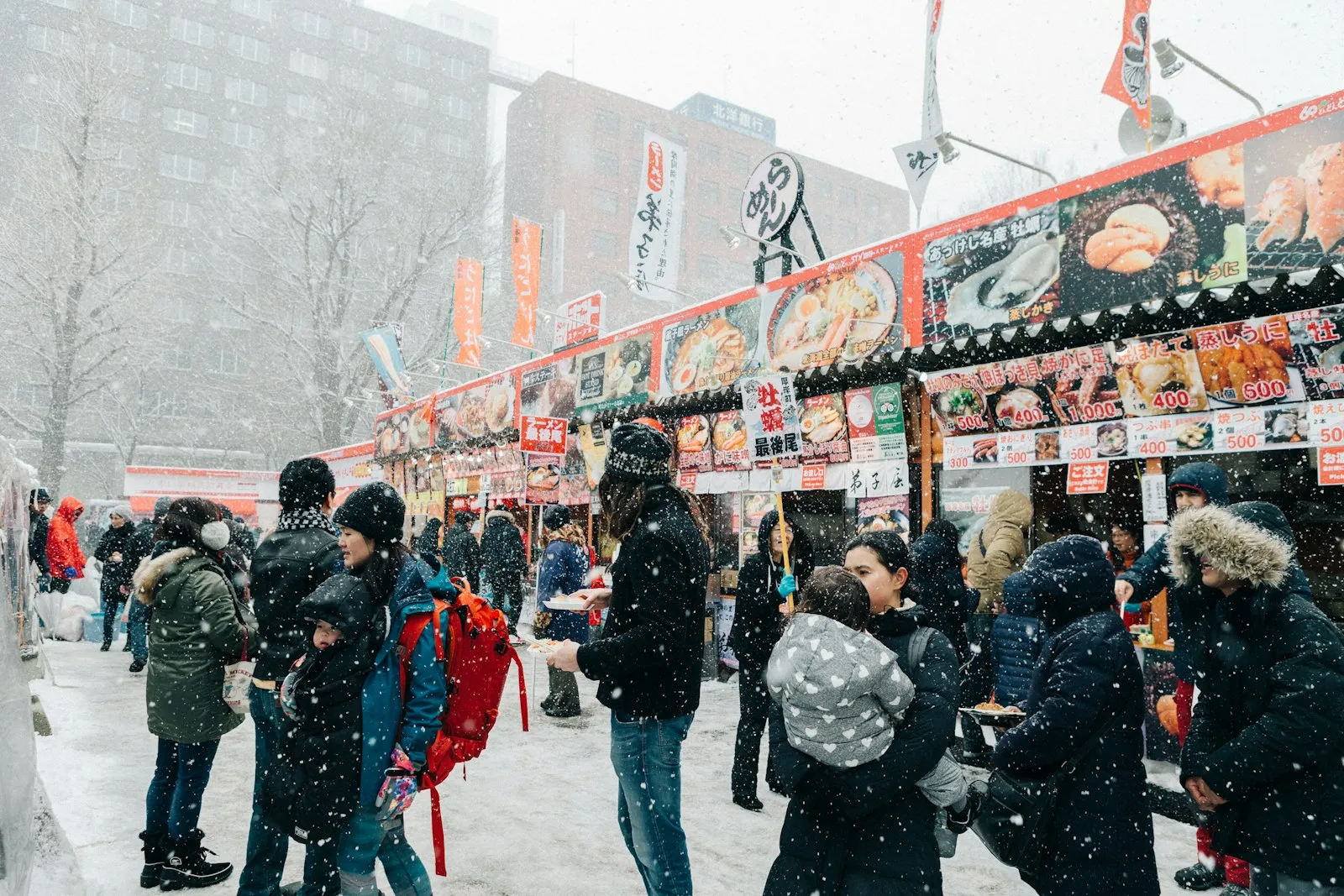
Sapporo is the big northern city, with just under two million people, and its coldest recorded temperature is minus 28.5 degrees, set in 1929. The Sapporo Snow Festival runs over seven days in February at Odori Park, Susukino and Tsudome; the dates move each year, so check them before you book anything. It started in 1950 with six statues built by six local high school students, and by 2007 about two million people were coming to see hundreds of snow and ice sculptures, 307 of them at Odori Park alone. An international snow sculpture contest has run at Odori since 1974. New Chitose Airport is one of six 24-hour airports in Japan and the fastest train reaches Sapporo Station in 37 minutes.
Niseko, and skiing without surprises
Niseko is a mountain region in Shiribeshi Subprefecture, Hokkaido, centred on the Niseko Volcanic Group, and it is known for winter sports, heavy snowfall and hot springs. Four ski areas on Niseko Annupuri are marketed together as Niseko United and share an all-mountain lift pass, which is the practical reason people base there. Lift-served skiing at Hirafu began in 1961, and Australian visitors and tourism businesses became prominent around Hirafu from about 2000, which is why so much of the area is served in English. Two things to sort before you fly: check that your travel insurance covers skiing, because standard cover often stops at the piste, and book early, since January and February are exactly when everyone else goes.
The snow monkeys at Jigokudani
Jigokudani Monkey Park sits in Yamanouchi, Nagano Prefecture, about 3.5 hours from Tokyo, inside Joshinetsu Kogen National Park. The name means Hell's Valley, after the steam and boiling water that come out of the frozen ground. Japanese macaques cope with temperatures down to minus 20 degrees and come down into the valley in winter; they started bathing in the hot springs after being encouraged to gather there in the 1960s, to keep them off local crops. The park sits at 850 m, snow covers the ground four months a year, and the only way in is a narrow two-kilometre footpath through the forest, which is what keeps it from feeling crowded. Wear boots you can walk a frozen path in.
Shirakawa-go, Kanazawa and the quiet middle
Between the two Japans sits the snow country of the centre. The historic villages of Shirakawa-go and Gokayama are three mountain villages over 68 hectares in the Shogawa river valley, a UNESCO World Heritage Site since 1995, known for gassho-zukuri farmhouses whose steep roofs are built to shed snow. Shirakawa village itself has about 1,630 residents and 95% of its visitors are day trippers, which tells you what an evening there is like. Kanazawa is the base for this side: its garden, Kenroku-en, is one of the Three Great Gardens of Japan and is noted for its beauty in winter, opening year round in daylight hours with paid admission. The Hokuriku Shinkansen has reached Kanazawa since 14 March 2015 and Tsuruga since 16 March 2024.
New Year, closures and signal in the cold
The one date to plan around is the New Year. Most companies voluntarily take a holiday from 29 December to 3 January, and depending on the industry some close from Christmas Eve to 5 January, so shops, small restaurants and offices shut while trains and shrines fill up. Book that week early or skip it. The rest of winter is the cheap, clear window for Tokyo and Kyoto, with the country's snow concentrated on the other side. For signal, NTT docomo's May 2026 list names a 5G SA spot at JR Sapporo Station and does not name Niseko, Jigokudani or Shirakawa-go; expect LTE there, which docomo reports at about 100% population coverage, with 5G depending on your handset, and docomo also says mountains and remote islands can still have no ground signal at all. It warns that New Year, events and disasters congest the network. Goodbars sells a Japan eSIM you install at home and switch on when you land; it runs on NTT docomo, Japan's largest mobile network by mobile contracts, and our Japan coverage page shows where it reaches and what independent speed tests measure.