What a day trip from Kyoto actually costs you
Kyoto sits in the middle of Kansai, and that is the whole reason these trips work. The region covers Hyogo, Kyoto, Mie, Nara, Osaka, Shiga and Wakayama, and the old capitals, the castle towns and the lake are all inside it. Everything below starts from Kyoto Station. The rule for the cheap ones is the IC card: tap in with a Suica or Pasmo and take a local train. The rule for the fast ones is the shinkansen, where a reserved seat is worth having in blossom and autumn weeks, and where a Japan Rail Pass only pays off across a long itinerary. Check the day's times in a transit app before you leave; these are all doable by lunchtime, and all ruinable by one missed connection.
Nara: the first capital, and the deer
Nara was the capital from 710 to 784, and eight temples, shrines and sites were inscribed together by UNESCO in December 1998. Nara Park, laid out in 1880 and one of the oldest parks in the country, covers about 502 hectares, or 660 if you count the grounds of Todai-ji, Kofuku-ji, the Kasuga Grand Shrine and the national museum around its edges. More than 1,200 wild sika deer live in it, protected as a natural treasure; they are wild animals, not a petting zoo, and the ones inside the park are noticeably smaller than sika elsewhere in Japan. Todai-ji is the one building you should not skip: founded in 738, opened in 752, and its Great Buddha Hall holds the largest bronze Buddha in the world.
Uji: the river, the tea and the Tale of Genji
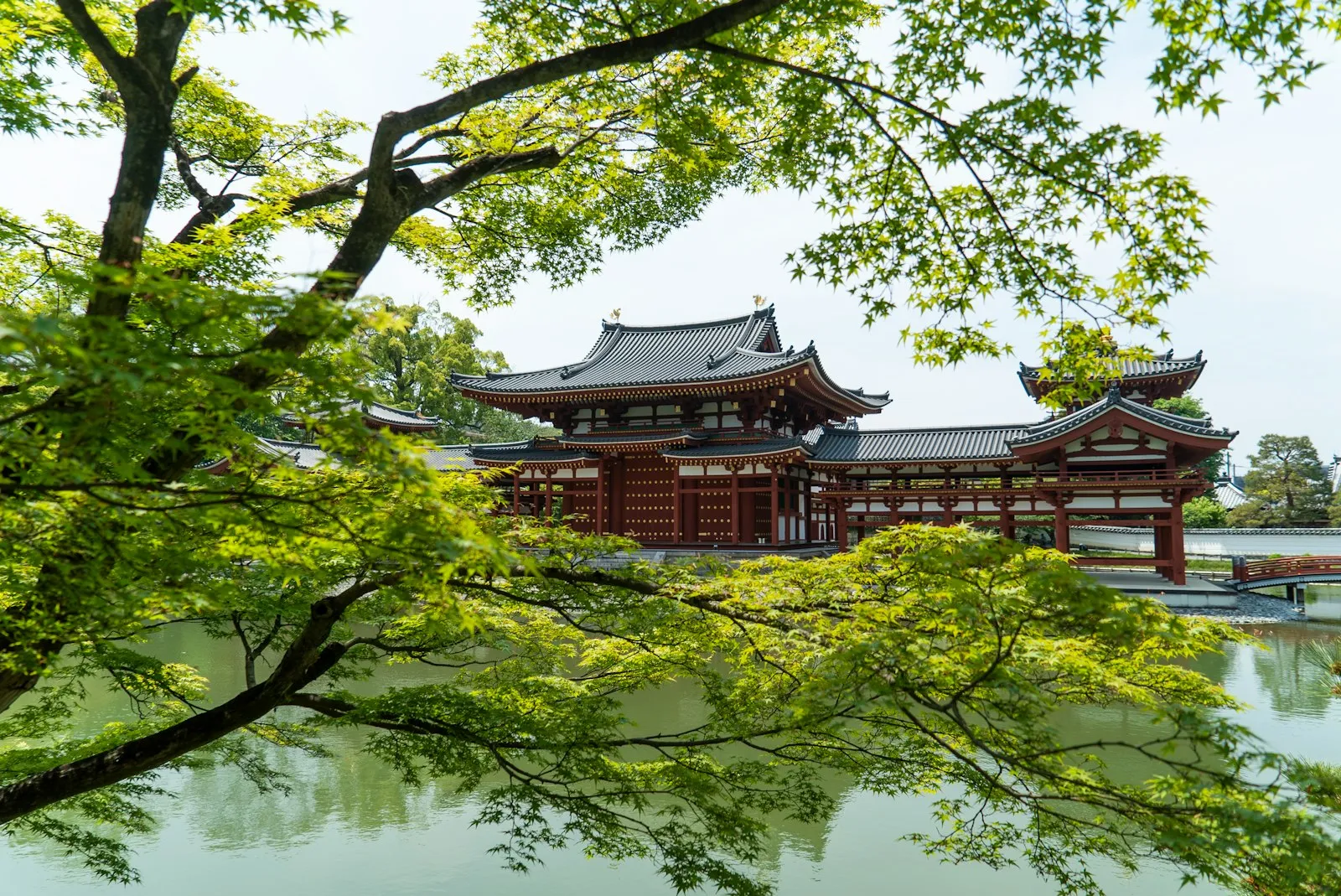
Uji is the short one, on the southern edge of Kyoto and between the two ancient capitals. The city sits on the Uji River, which runs out of Lake Biwa, and it is the literary day trip: Murasaki Shikibu set much of the final part of The Tale of Genji here, in the eleventh century. Two of its buildings, the Byodo-in and the Ujigami Shrine, built in 1060, belong to the same UNESCO listing as Kyoto's monuments. Tea has been part of the town's business since the fifteenth century, when shoguns had tea-ceremony jars brought here. Half a day is enough, and it is the trip to take when the forecast is poor and you want a river rather than a queue.
Himeji Castle: the one that survived
Himeji is the long one and the one worth the effort. The castle is a hilltop complex of 83 structures, the finest surviving example of the Japanese castle, white enough to be nicknamed the White Heron. It was registered in December 1993 as one of the first UNESCO World Heritage Sites in the country, went through five years of restoration from April 2010 and reopened on 27 March 2015. Of the 84 gates it originally had, 21 are still standing. The city is about 1.5 hours west of Osaka by train, so check your own time from Kyoto in a transit app and leave early: this is a half-day building inside a full-day journey.
Kobe and Arima Onsen: a port and a bath
Kobe is 70 km south-west of Kyoto, Japan's seventh-largest city and its third-largest port city, squeezed between the mountains and Osaka Bay. Its Ikuta Shrine has a founding story the Nihon Shoki puts in the year 201, and the Great Hanshin earthquake of 1995 is the more recent history the city rebuilt around. Behind it, in the hills of Kita ward near Mount Rokko, Arima Onsen has been named in Japanese writing since the eighth century, listed in The Pillow Book as one of the three famous springs and rated the most prestigious in the Edo period. Bathing rules are the usual ones: wash before you get in, keep the small towel out of the water, and check the tattoo policy first.
Lake Biwa, and what to carry
Lake Biwa is the easiest escape from temples: the largest freshwater lake in Japan, entirely inside Shiga Prefecture, north-east of Kyoto, about 670 square kilometres of water that supplies about 15 million people in Kansai and was designated a Ramsar wetland in 1993. It is also an ancient lake, over four million years old and reckoned the thirteenth oldest in the world. Take it as an afternoon rather than a programme.
For all five trips: carry your passport, which you are required to have on you, carry cash for small places, and remember that a Japan Rail Pass only comes in 7, 14 or 21 consecutive days and that Nozomi and Mizuho services have needed a supplement since 1 October 2023. Goodbars sells a Japan eSIM you install at home and switch on when you land; it runs on NTT docomo, Japan's largest mobile network by mobile contracts, and our Japan coverage page shows where it reaches and what independent speed tests measure.