Six tournaments, fifteen days each
A honbasho, a grand sumo tournament, is the only thing that counts. Only honbasho results decide promotion and relegation on the banzuke, the ranking list, so everything else you might see is an exhibition. Since 1958 there have been six of them a year, each running fifteen consecutive days, held every other month with the first in January, across four locations. The Japan Sumo Association has organised them since 1926, when the Tokyo and Osaka associations merged. Before the nineteenth century a wrestler's record barely mattered and both the number of tournaments and their length moved around; the modern calendar is what makes planning possible at all.
Where they are held
The six tournaments rotate between four locations. The one visitors most often aim for is Tokyo's Ryogoku Kokugikan, the hall in its current form since 1985. We are not going to guess the other three cities or their months from memory: the Japan Sumo Association publishes the schedule, and it is the only list worth trusting when you are picking dates. Check it before you fix flights, because a tournament month is also a month when that city's hotels fill, and because the fifteen days are consecutive, a trip that lands in the middle of one is easier to arrange than one that brackets it.
Tickets, and what we will not quote
We do not quote a ticket price, because we could not verify one from an official source. Buy through the Japan Sumo Association's own channels, and check the schedule on the same site rather than a summary elsewhere. Two things worth planning around: the tournament runs for fifteen straight days, so a weekday is a softer target than a weekend, and the ranking system means the interesting bouts are the ones between wrestlers whose position on the banzuke is at stake. If you only have one free day in a tournament city, take it; if you have a choice of days, a later one in the fifteen carries more weight.
What you are actually watching
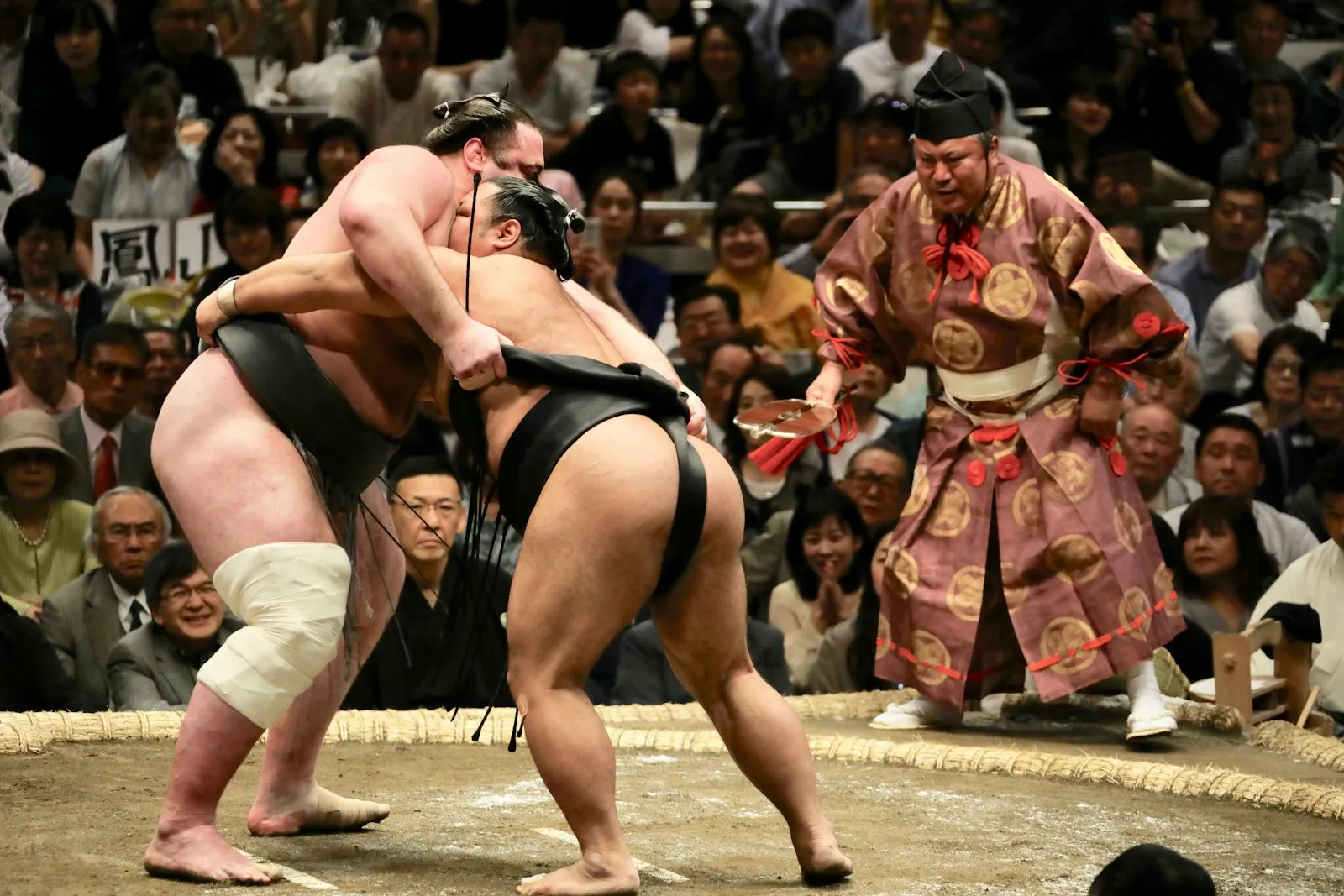
The rule is short: a wrestler wins by forcing his opponent out of the dohyo, the circular ring, or by making him touch the ground with any part of his body other than the soles of his feet, usually by throwing, shoving or pushing him down. Around that sit centuries of ritual, much of it from Shinto, including the salt thrown to purify the ring. Sumo is considered a modern martial art with a very long history, and Japan is the only country where it is practised professionally. The first mention of it is in a Kojiki manuscript from 712, where possession of the Japanese islands is settled by a wrestling match between two kami.
The life behind the fifteen days
Most wrestlers live in communal training stables, heya, where the association's rules set everything from meals to how they dress. In 2007, 43 stables housed 660 wrestlers. Junior wrestlers get up earliest, around 5 am, to train, while the ranked sekitori start nearer 7 am, and the regime is hard on the body: life expectancy in sumo is much lower than average. The money shows the same steepness. A divisional championship pays from 100,000 yen in the lowest division up to 10 million yen for winning the top one, and each of the three special prizes for an outstanding top-division performance is worth 2 million yen.
Out of season, and staying connected
If your dates miss all six tournaments, January has one free alternative. A yokozuna performs the ring-entering ceremony, the dezuiri, at Meiji Jingu in Tokyo in January, usually around the 5th to the 7th, and again at the shrine's autumn festival. Meiji Jingu is open every day and free to enter, and it sits in a 70-hectare forest of 120,000 trees given by people from across Japan when the shrine was built. If you are invited to watch morning practice at a stable, treat it as someone's workplace: arrive when you are told, sit still and stay quiet. For signal, NTT docomo's May 2026 list names 5G SA spots at the east exit of Shinjuku Station and at the Shibuya scramble crossing, and it warns that events congest the network; LTE is reported at about 100% population coverage, with 5G depending on your handset. Goodbars sells a Japan eSIM you install at home and switch on when you land; it runs on NTT docomo, Japan's largest mobile network by mobile contracts, and our Japan coverage page shows where it reaches and what independent speed tests measure.