What counts as an onsen
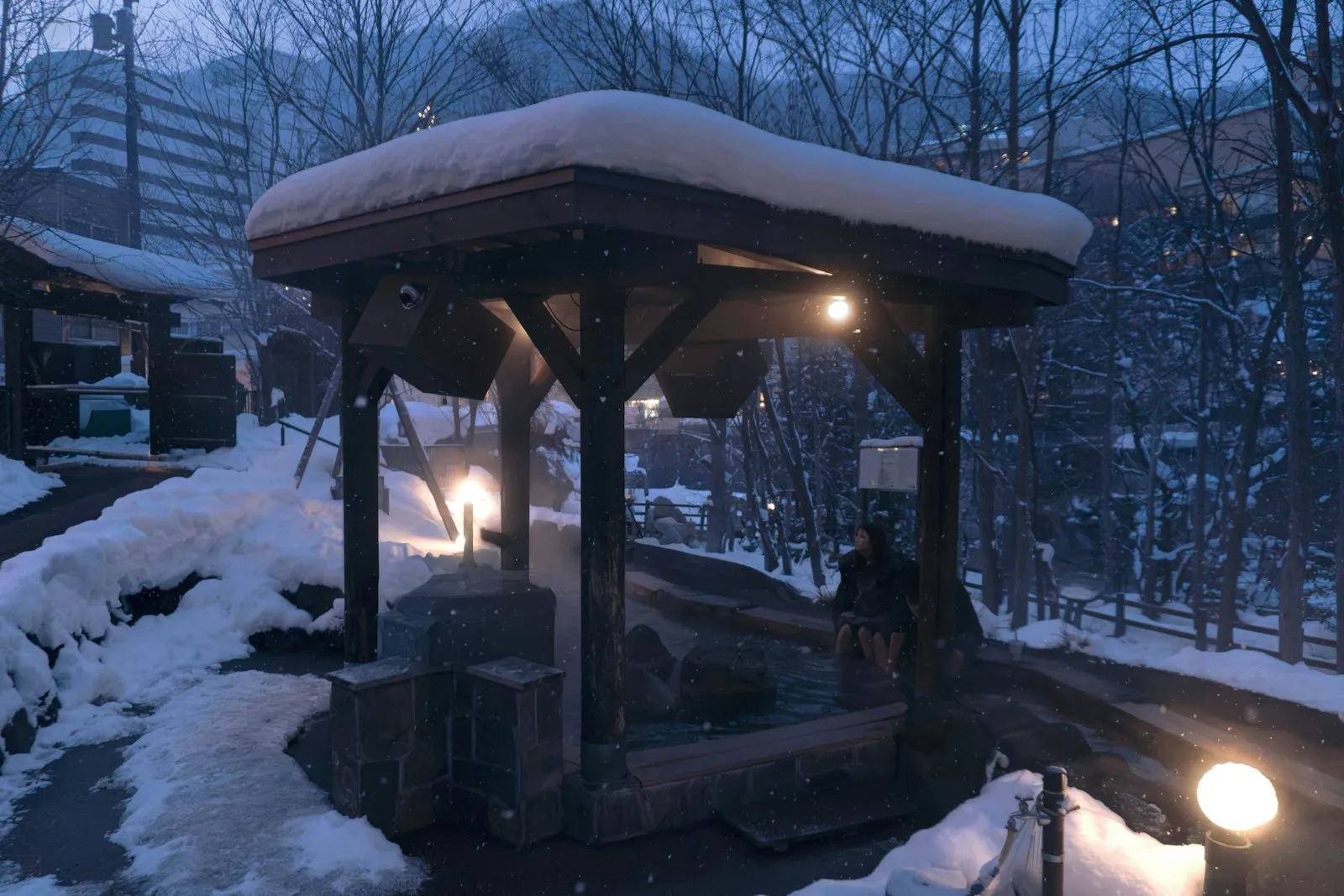
An onsen is defined by law, not by decor. The water must be at least 25 degrees at the source, must originate at a depth of at least 1.5 kilometres, and must contain specified amounts of minerals such as sulphur, sodium, iron or magnesium. Japan has roughly 25,000 hot spring sources and about 3,000 onsen establishments using naturally heated water from them. Baths are either outdoor, rotenburo, or indoor, uchiyu, and many inns now have both. Some are run by a municipality, others are attached to a hotel, a ryokan or a small family inn. You will find them on signs and maps by the symbol for hot water rather than by a word you can read: a curl of steam over a bowl, the kanji yu, or the hiragana character for the same sound.
The bath, in order
You bathe nude, and the bath is not where you get clean. Baths are separated by sex, you undress completely in the changing room and leave everything but a small towel, then sit at one of the washing stations and wash and rinse thoroughly before you go anywhere near the water. The small towel never goes in: people fold it on their head or leave it at the edge. Mixed bathing is banned in public baths, and where a couple or a family wants to bathe together the answer is a private bath you reserve. Wikipedia notes that in some prefectures nude mixed bathing is not permitted and visitors have to wear swimsuits, so read the notice at the entrance rather than assuming. Keep your voice down, no phones or cameras in the changing room, and take a slow walk back rather than a shower.
Tattoos: the honest position
Tattoos will keep you out of some baths, and there is no way to know in advance except to ask. The UK FCDO puts it plainly: some public facilities do not admit people with tattoos, for example public swimming pools, hot springs, beaches and some gyms, and other establishments request that you cover them. The practical workarounds are the ones people use everywhere here: a private bath you reserve for yourself, an inn whose own baths are for guests only, or skin-coloured cover-up patches for something small. Ask at the desk before you pay, not once you are undressed, and take a refusal without an argument. Some places have relaxed the rule and some have not, and the person at the desk is not the one who wrote it.
The towns worth the trip
Four names cover most first trips. Hakone, a town in Kanagawa Prefecture with a population of 10,965 as of October 2023, is the classic: a spa town whose hot springs sit within view of Mount Fuji, with Lake Ashi and the Hakone Shrine to fill the daylight hours. Arima Onsen, in Kita ward in Kobe near Mount Rokko, is the old one: named in the Heian-period Pillow Book as one of the three famous springs of Japan, selected as the most prestigious during the Edo period, mentioned in documents since the eighth century and visited by Toyotomi Hideyoshi in the sixteenth, and easy to reach from Osaka and Kobe. Nikko, spread over rural Tochigi at elevations from 200 to 2,000 metres, has many famous hot springs alongside its shrines. Niseko in Hokkaido pairs heavy snowfall with hot springs. Dogo, on Shikoku, is the other name people will give you.
An hour, or a night
The difference between a good onsen visit and a great one is usually whether you sleep there. Onsen inside a ryokan or a hotel are generally kept open 24 hours a day, or closed only for a brief daily cleaning, so guests can bathe in the middle of the night; that is the version people remember, an empty outdoor bath at two in the morning. Traditional ryokan are most common in areas with natural hot springs and hard to find in Tokyo and other big cities, where they cost more than a modern hotel, which is another reason the onsen trip is a night out of town. If you only have an afternoon, a municipal or hotel bath that admits day visitors does the job, and an onsen town will usually have one.
Who should not bathe, and signal in the valleys
Hot water is a medical question for some people, and Japan treats it as one. Article 18 of the Hot Springs Act requires guidance to be published on contraindications and cautions for bathing in hot springs and for drinking their waters, which is why there is a notice board at the entrance you should actually read. If you are pregnant, have a heart condition or high blood pressure, or are on medication, take that notice and your doctor's advice seriously, keep the sessions short, drink water, and do not bathe after drinking alcohol.
On signal, these are mountain valleys. Our carrier names Dogo Onsen on Shikoku among the places where it has been adding 5G standalone capacity, but it makes no coverage statement for most onsen towns, and its own service notes say mountains and remote areas can still be out of reach. Download your maps and train times before you go up the valley. Goodbars sells a Japan eSIM you install at home and switch on when you land; it runs on NTT docomo, Japan's largest mobile network by mobile contracts, and our Japan coverage page shows where it reaches and what independent speed tests measure.